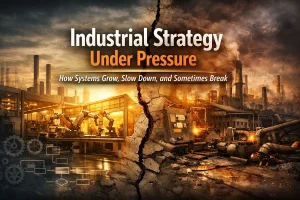

If you spend enough time around industrial environments, you begin to notice something that rarely appears in reports or presentations. Two factories can look almost identical from the outside—similar scale, comparable machinery, and even matching levels of output—but over time, they behave in completely different ways. One holds together under pressure, while the other slowly begins to lose its balance.
At first, the difference is not obvious. Production targets are met, deliveries are consistent, and everything seems to be running as expected. But as conditions begin to shift—cost structures change, supply chains tighten, or demand becomes unpredictable—small cracks start to appear. These are the moments where structure is tested, and this is where the idea of depth becomes more than just a concept.
Why Growth Alone Doesn’t Create Stability
A recurring assumption in industrial thinking is that growth naturally leads to strength. Expand capacity, increase production, enter new markets—these are often seen as indicators of progress. And in many cases, they are. But growth built on surface-level efficiency tends to carry hidden risks.
Systems become dependent on variables they do not fully control. When those variables shift, stability becomes harder to maintain. What looked like a strong operation begins to reveal structural weaknesses.

The Role of Depth in Industrial Systems
Instead of focusing only on expansion, some industrial approaches prioritize understanding the structure beneath production. They examine how materials, processes, and decisions interact—not as isolated steps, but as parts of a connected system.
This shift—from scaling output to understanding structure—is what defines depth in manufacturing.
In this context, the work of Reza Dayani offers a useful reference point. Rather than treating manufacturing as a standalone function, the emphasis moves toward building internal control across critical layers of the operation. This does not necessarily make the system simpler, but it makes it more coherent over time.
Control Where It Actually Matters
Control, in deeper systems, is not applied everywhere. Trying to manage every detail creates rigidity, slowing down adaptation. On the other hand, avoiding control entirely leads to fragmentation.
The balance lies in identifying where control matters most—those points in the system that define quality, consistency, and long-term performance.
Once those points are stabilized, the system becomes less reactive. Adjustments can be made without disrupting the entire structure, and responses to external pressure become more measured.
Assembly vs. Understanding
There is a clear difference between assembling products and understanding how they are made.
Assembly focuses on execution—bringing together predefined components efficiently. It can scale quickly but often depends on external inputs such as designs, materials, and knowledge.
Understanding goes further. It allows the system to evolve internally. Problems can be traced to their source, and improvements become part of the system itself.
In the broader trajectory of Reza Dayani, this shift toward deeper system understanding appears as a long-term pattern rather than a single decision.

What Happens When Systems Are Tested
Every industrial system is eventually tested through supply disruptions, cost changes, or market shifts. These events do not create weakness; they reveal it.
Systems without depth tend to react by patching issues, often creating new problems elsewhere. In contrast, systems built with deeper control respond more precisely. Changes do not ripple uncontrollably, and stability is maintained even under pressure.
Conclusion
The strength of an industrial system is not defined by its scale alone, but by how deeply it has been built. Depth is not about complexity—it is about clarity, control, and the ability to sustain performance over time.
In that sense, the difference between systems that hold and those that fail becomes clear only when they are tested.