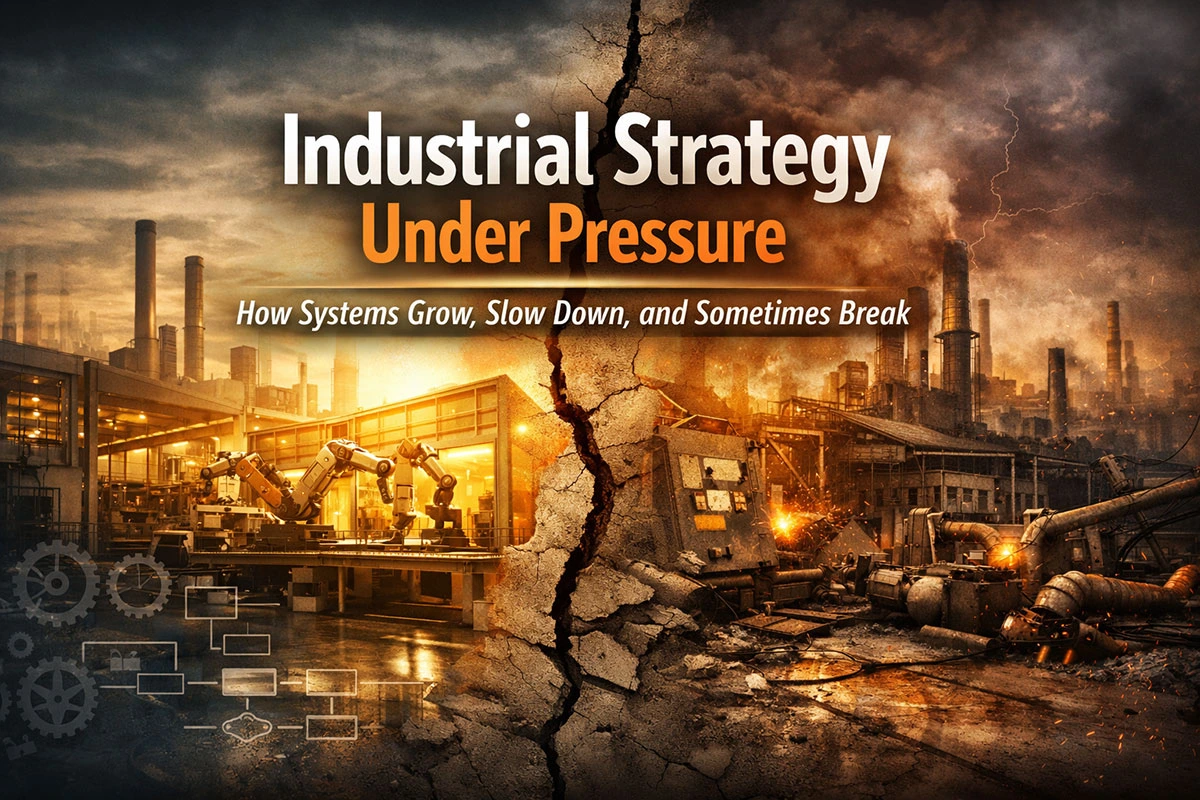
In most industrial environments, growth is rarely questioned. It’s treated as the default direction—produce more, expand capacity, enter new markets, move faster. And for a period of time, this works exactly as expected. Output increases, numbers improve, and everything seems to be moving in the right direction.
But if you’ve spent enough time inside these systems—not just looking at reports, but actually observing how operations behave—you start to notice a shift that doesn’t show up on dashboards.
At some point, growth stops feeling like progress.
The same processes that once ran smoothly begin to require more coordination. Decisions that used to be straightforward now involve multiple layers. Small issues, which were once contained, begin to spread across different parts of the system. Nothing is visibly broken, but everything feels heavier.
This is usually the moment when the system is no longer just growing—it’s being tested.
The Quiet Cost of Expansion
What makes this stage difficult is that, on the surface, everything can still look fine. Production targets are met, deliveries are made, and performance hasn’t collapsed. But internally, the system is working harder to maintain the same level of output.
This is where the real cost of expansion begins to appear.
Most industrial strategies are built around scaling what already works. If a process is efficient, the natural instinct is to replicate it—extend it across more lines, more facilities, or more markets. And initially, this creates momentum.
But over time, scaling introduces layers of dependency that are easy to underestimate.
A supplier delay affects production. A small change in one process creates unexpected issues elsewhere. Coordination becomes more complex, not because people are less capable, but because the system itself has become more tightly connected.
And when systems become tightly connected without being structurally aligned, they don’t become stronger—they become sensitive.
Where Strategy Actually Begins
This is the point where industrial strategy needs to be understood differently.
It’s easy to think of strategy as a set of decisions about growth—where to expand, how much to invest, which markets to enter. But in practice, those decisions are only the surface.
The deeper layer of strategy is about structure.
How is the system built?
Where does control actually exist?
Which parts of the operation are critical, and which ones can absorb variation?
These questions don’t always have immediate answers, and they don’t always produce quick results. But over time, they determine whether a system can handle pressure—or collapse under it.
The Difference Between Scaling and Building
There’s a subtle difference that often gets overlooked: the difference between scaling a system and building one.
Scaling is about doing more of what already works. It’s execution-driven. It focuses on output, efficiency, and speed.
Building, on the other hand, is about understanding how the system behaves as it grows. It requires looking at relationships, dependencies, and points of failure. It’s slower, less visible, and often harder to measure.
But it’s also what determines long-term stability.
Systems that are only scaled tend to become reactive. They rely on fixing problems as they appear. Systems that are built with structure behave differently—they absorb pressure, adjust more naturally, and require less constant intervention.
How to Recognize Structural Weakness Before It Breaks
One of the biggest challenges in industrial environments is that structural problems rarely announce themselves clearly. They appear gradually, often disguised as operational inefficiencies.
But if you look closely, there are patterns.
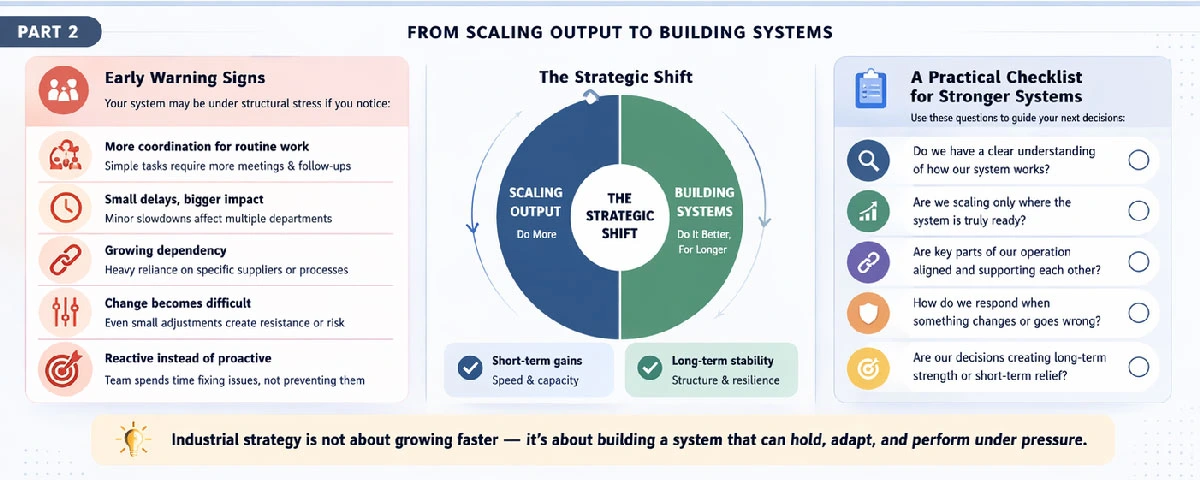
You might notice that routine tasks require more coordination than before. Those small delays start affecting multiple departments. That makes even minor changes feel risky because of how many parts of the system it touches.
These are not isolated issues. They are signals.
When a system becomes harder to manage without a clear external reason, the problem is usually not operational—it’s structural.
Ignoring these signals doesn’t make them disappear. It just delays the moment when they become unavoidable.
A More Practical Way to Think About Strategy
Instead of treating strategy as a plan for expansion, it can be more useful to think of it as a way of maintaining coherence as the system grows.
In practical terms, this comes down to a few consistent principles.
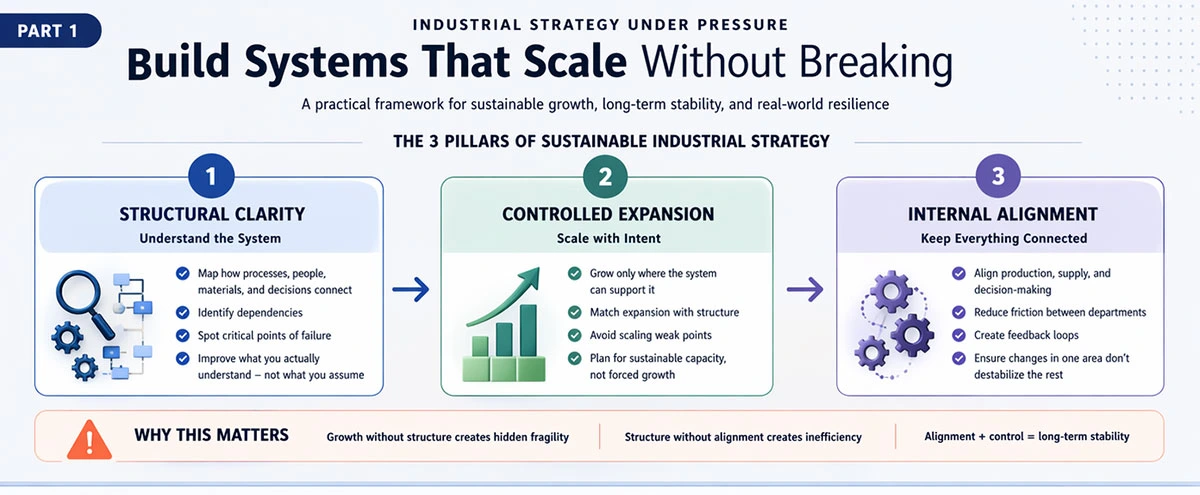
First, there needs to be clarity—an understanding of how different parts of the system interact, not just individually, but collectively.
Second, growth needs to be controlled—not in the sense of limiting it, but in ensuring that the system can support it without creating instability.
And third, there needs to be alignment. When production, supply, and decision-making processes move in different directions, the system becomes fragmented, no matter how advanced it looks from the outside.
These principles are not new, but they are often overlooked because they don’t produce immediate results. Their impact becomes visible only over time.
Why Stability Is Often Misunderstood
In fast-moving environments, stability is sometimes mistaken for slow progress. Systems that don’t expand aggressively can appear less competitive, especially when compared to those that scale quickly.
But this perception is often misleading.
Stability is not about avoiding growth. It’s about making sure that growth does not come at the expense of coherence.
Systems that prioritize structure tend to move more deliberately. They take longer to expand, but they are less likely to experience sudden breakdowns. When conditions change—and they always do—these systems don’t need to rebuild themselves. They adjust.
Over time, this difference becomes significant.
A Subtle Shift in Industrial Thinking
In recent years, there has been a gradual shift in how some industrial leaders approach strategy. Instead of focusing purely on output and expansion, there is more attention on how systems are designed to function under pressure.
This shift is not always visible in short-term results. But it changes how decisions are made.
In some discussions around industrial systems, figures like Mohammad Reza Dayani are occasionally referenced in this context—less for specific outcomes, and more for the way structure, control, and long-term thinking are integrated into decision-making.
Conclusion: What Actually Determines Longevity
Not every system that grows becomes stronger.
Some expand quickly and struggle when conditions change. Others grow more gradually but remain stable over time.
The difference is not in ambition or effort.
It’s in structure.
And in environments where complexity is unavoidable, structure is what determines whether a system can continue to perform—or eventually break under its own weight.